When people spoke up about patient transport, things started to change
Getting to healthcare is not always straightforward in North Yorkshire.
Long distances, limited public transport, and the cost of travel mean that for some people, attending an appointment is not just inconvenient, it can be difficult or even impossible.
Earlier this year, we shared what people told us about non emergency patient transport and recent changes to who can access it.
What people told us was clear. Transport is not a side issue. It affects whether people can get care at all.
Since then, we have started to see changes.
What has happened so far
Following our report, organisations across the area have begun to respond, including the NHS Humber and North Yorkshire Integrated Care Board, which plans and pays for most local NHS care, and some local hospital groups.
York and Scarborough Teaching Hospitals NHS Foundation Trust have made a number of practical changes.
Volunteer drivers from community transport schemes can now access free parking at hospital sites, making it easier for them to wait with patients and support journeys.
They have also made clearer information available on their website about the Healthcare Travel Costs Scheme, helping people understand what financial support they may be entitled to, after people told Healthwatch they did not know they could claim help with travel costs.
At the same time, South Tees Hospitals NHS Foundation Trust and colleagues at University Hospitals Tees are planning new transport options.
This includes a proposed bus service linking rural areas with hospital sites such as James Cook and the Friarage, with routes expected to extend into North Yorkshire. The new service could support around 8 to 12 patients a day, where there was previously no provision.
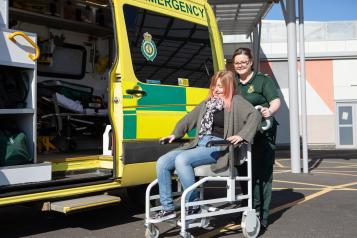
In response to what people told us, there are also plans to increase the number of wheelchair accessible vehicles available.
Alongside this, some services are starting to look more closely at how appointments are arranged. This includes grouping appointments together or offering alternatives, so people do not have to make multiple difficult journeys.
Looking at how care fits around people
People told us that getting to multiple appointments, often on different days and in different places, made things harder.
At South Tees Hospitals NHS Foundation Trust, teams are reducing the need to travel by offering telephone appointments where appropriate, particularly in cancer care, and looking at how diagnostics and treatment can be brought closer to people’s homes.
At York and Scarborough Teaching Hospitals NHS Foundation Trust, some teams are coordinating care more closely. For example, retinal screening teams are looking at when people are already attending appointments at York Hospital and other sites, so checks can be done on the same day rather than requiring another journey.
There has also been a focus on where clinics are held. At York and Scarborough Teaching Hospitals NHS Foundation Trust, musculoskeletal (MSK) teams, who support people with joint, muscle and back problems, have been reviewing where clinics take place across North Yorkshire so they are easier to reach, rather than always being based at a single hospital site.
Alongside this, South Tees Hospitals NHS Foundation Trust is increasing the use of one stop clinics and community diagnostic hubs, so people can have tests and appointments in one place where possible, rather than travelling multiple times.
Wider action and discussion
Our report has also helped raise the issue more widely.
The people in charge of the NHS Humber and North Yorkshire Integrated Care Board have said they will look to bring organisations together to discuss the findings and consider community transport more broadly.
Local Members of Parliament, including Rishi Sunak, Tom Gordon, and Alison Hume, have also been in touch or written to organisations to ask how the recommendations will be taken forward.
The report has also been shared in regional forums, including a meeting of the Experience of Care Council at University Hospital Tees, helping to keep the issue on the agenda.
What is being looked at next
Alongside these early changes, there is ongoing work to look at what needs to happen longer term.
This includes:
- reviewing eligibility criteria to make sure those most in need can access transport
- improving consistency so people can get to all appointments for a condition, even across different locations
- developing and supporting community transport options, including funding and long term sustainability
- raising awareness of financial support available to patients
- better understanding how transport affects missed appointments and health outcomes
Some services are also exploring how to better use appointment data to understand travel barriers, although this is still developing.
Why this matters and what this shows
For many people, transport is the difference between getting care and going without.
People told us about:
- cancelling appointments because they could not afford the journey
- spending hours travelling for short appointments
- relying heavily on family and friends
- having no suitable or safe way to get there
In rural areas like North Yorkshire, these challenges can be even greater because of distance and limited transport options.
What this shows is that when people speak up, it can lead to change.
Not everything is fixed, and some of this work is still in the early stages. But there is real movement, and a growing recognition that transport needs to be part of how care is planned around people’s lives.
We will continue to follow this work and share what happens next.